
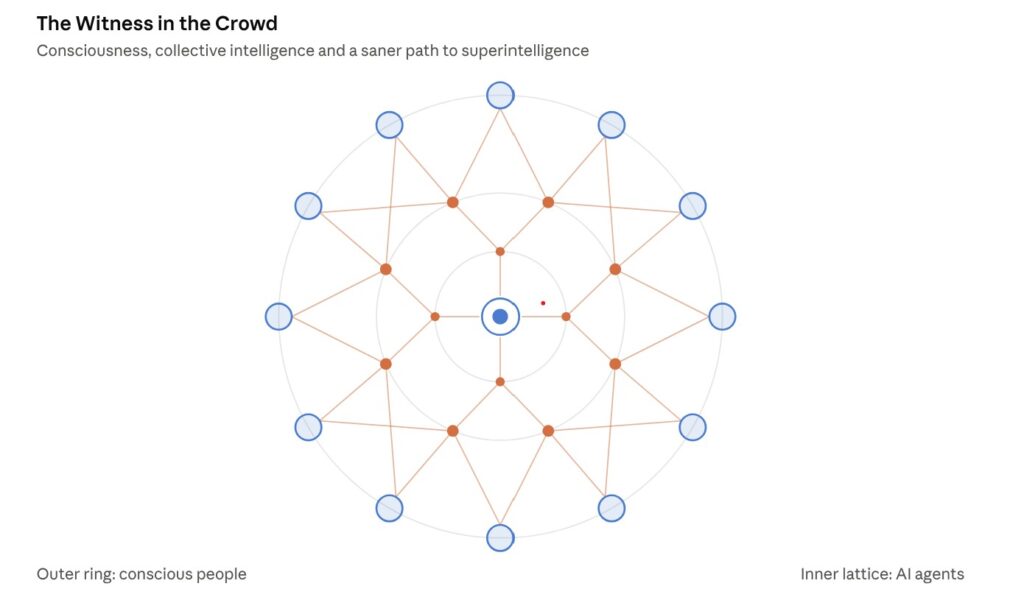
People around a lattice of machines, with one witness at the center
When Mark Zuckerberg announced Meta Superintelligence Labs in June 2025, the memo talked about delivering “personal superintelligence for everyone” (Fortune). He is far from the only leader talking this way, and the picture most people carry around is the same: one enormous model, trained on everything, smarter than all of us.
I think that picture is incomplete, and possibly dangerous.
In my last article I argued, with help from the Upanishads, that intelligence and consciousness are different things. A system can get far more capable without anyone being home. This piece picks up where that one stopped. If the most powerful minds we build may have no inner life, no felt sense of what matters, then where does wisdom come from? My answer, and the thread running through the research I’ll walk you through, is that it has to come from us. Not from one of us. From many of us, organized well, with machines in the loop.
That is the idea behind artificial collective intelligence. I think it is the most realistic, and the safest, road to superintelligence we have.
What consciousness gives a mind that raw intelligence doesn’t
Strip away the philosophy and consciousness does three practical jobs for us.
It makes things matter. Pain, curiosity, love, shame: experience is how a human mind knows what is worth caring about. A model can rank options brilliantly. It has no stake in which one wins.
It watches. The Vedantic tradition calls this the sakshi, the witness, the part of you that notices your own anger before you act on it. It is the original oversight function.
It answers for itself. We hold conscious beings accountable because there is someone there to hold. A board can fire a CEO. It cannot meaningfully fire a model.
Intelligence without these three is an amplifier. It makes whatever it is pointed at bigger and faster. The AI field has a polite name for the problem of choosing where it points: alignment. I prefer the old word, wisdom. And wisdom, so far, has only ever lived in conscious beings, usually working together.
What we actually know about collective intelligence
The best-known study on this is now sixteen years old. In 2010, Anita Woolley, Thomas Malone and colleagues put 699 people into small groups and gave them everything from visual puzzles to negotiations to design problems. They reported that groups, like individuals, have a general intelligence of their own, which they called the c factor. It explained roughly 40% of the variation in how groups performed across very different tasks (Woolley et al., Science).
In that study, the interesting part was what predicted it. Not the average IQ of the members, and not the IQ of the smartest person in the room. What mattered was how well members read each other’s emotions, and whether they took turns speaking. Groups where one person dominated did worse.
I should be straight with you: this finding has been fought over. In 2017, Marcus Credé and Garett Howardson reanalyzed the data and argued it did not support a single general factor at all (ScienceDaily). Psychologists Bates and Gupta ran three studies of their own with 312 people and found that members’ individual IQ explained most of the difference between groups, while the effects of turn-taking and the share of women in the group did not hold up (Bates and Gupta, Intelligence).
Woolley’s team answered in 2021 with a much larger meta-analysis: 22 studies, 5,349 people, 1,356 groups. It found strong support for a general factor, and found that how a group collaborates mattered about twice as much as the skill of its individual members. Social perceptiveness still predicted performance (Riedl et al., PNAS).
My reading of the whole debate: nobody disputes that capable people help. The argument is over how much the quality of their interaction adds on top, and the biggest body of evidence says it adds a lot. Every enterprise leader has seen the practical version. A team of stars that can’t listen often loses to a team of good people who can.
That points back to consciousness. Reading another person’s emotions is an act of empathy, which means one experiencing being modeling another. I’d argue the ingredient that made those groups smart was, at its root, a conscious one.
When machines join the crowd
So what happens when we add AI to the group? The honest answer from the research is: it depends entirely on how we wire it in. Here is the evidence I find most telling, good news first.
AI can help people find common ground. Google DeepMind built a system nicknamed the Habermas Machine and tested it with about 5,000 people in the UK, in groups of six. The model drafted a group statement from everyone’s views, took their critiques, and redrafted. Participants preferred its statements to those written by a human mediator from the group 56% of the time, and agreement within groups rose by about 8% (Tessler et al., Science).
The critics deserve a hearing too. Stanford’s James Fishkin, who has spent decades running deliberative polls, pointed out that the process had little real dialogue and no expert briefing, so poorly informed views could flow straight into the shared statement (Singularity Hub). He’s right, and it matters for everything that follows. Agreement is not the same thing as good judgment. A machine that is very good at finding common ground can also be very good at finding the wrong common ground.
The public can shape how AI behaves. In 2023, Anthropic and the Collective Intelligence Project asked about 1,000 representative Americans to write principles for an AI model. They contributed 1,127 statements and cast more than 38,000 votes. The model trained on the public’s principles showed less bias across nine social dimensions than the one trained on the company’s own, with no loss in capability (Anthropic).
Now the harder news.
Human plus AI is not automatically better. An MIT meta-analysis of 106 experiments found that, on average, human-AI teams did worse than the best of humans or AI working alone. Teams beat AI alone mainly when the humans were already better than the AI at the task, and they did best on creative work rather than decisions (Vaccaro et al., Nature Human Behaviour). The weak point was judgment about when to trust the machine.
AI makes us individually better and collectively more alike. In a study of 300 writers, those given AI story ideas wrote stories judged more novel, and the least creative writers gained the most. But the stories also became about 10% more similar to each other (Doshi and Hauser, Science Advances). Scale that across an organization, or a society, and you erode the diversity that makes groups smart in the first place.
AI trained on AI degrades. Ilia Shumailov and colleagues showed that models trained on the output of earlier models lose the rarer parts of what they learned, generation after generation, until the output stops making sense (Shumailov et al., Nature). The fresh, varied signal comes from people.
Jason Burton, Anita Woolley and colleagues pulled these threads together in Nature Human Behaviour: large language models can widen who gets heard, but they can also manufacture a false sense of consensus by smoothing out minority views (Burton et al.). And Henry Farrell, Alison Gopnik, Cosma Shalizi and James Evans argued in Science that we should stop thinking of these models as minds at all. They are cultural and social technologies, closer to markets, bureaucracies and libraries, that compress what humans know (Farrell et al., Science).
That last framing is the one I find most useful. If AI is a social technology, the real question is whether it will make our collective mind wiser or dumber.
Is there such a thing as a collective consciousness?
If groups can be intelligent, can they be conscious? This is where I want to be careful, because it is easy to slide into mysticism.
The Vedantic tradition does distinguish between vyashti, the individual, and samashti, the collective or cosmic whole. Émile Durkheim spoke of a “collective conscience” binding a society. But both were describing shared meaning and shared values, not a group that literally has experiences.
The science is blunter. Integrated information theory, one of the leading accounts of consciousness, explicitly says that aggregates such as groups of individuals are not conscious, however well they cooperate (Tononi and Koch). A team doesn’t feel anything. Its members do.
I find this clarifying rather than disappointing. It means the consciousness in any collective lives in its human members, one person at a time. A collective can multiply intelligence. It cannot conjure up a conscience. That has to be supplied, continuously, by the conscious people inside it, which is precisely why removing them from the loop is so risky.
Three roads to superintelligence
Nick Bostrom’s 2014 book Superintelligence described three forms a superhuman mind could take (summary). A speed superintelligence thinks like us, only far faster. A quality superintelligence thinks in ways we can’t. A collective superintelligence is many smaller minds organized so that the whole outperforms any part.
Judging by where the headlines and the largest budgets go, most of the effort today is on the first two roads: ever larger single models. The third road gets far less attention, which is odd, because it is the only one we have already travelled. Science, markets and the open-source movement are all collective intelligences that outperform any individual in them.
The same lesson about structure is showing up in machine collectives. A 2026 study simulated groups of AI agents across 30 kinds of tasks and found that how agents are connected matters a great deal for specific tasks, with effects of up to 1.84 standard deviations on coordination problems. Dense, decentralized networks did best at generating ideas and coordinating; negotiation went better when a few generalist agents mediated between specialists (Meluso et al.).
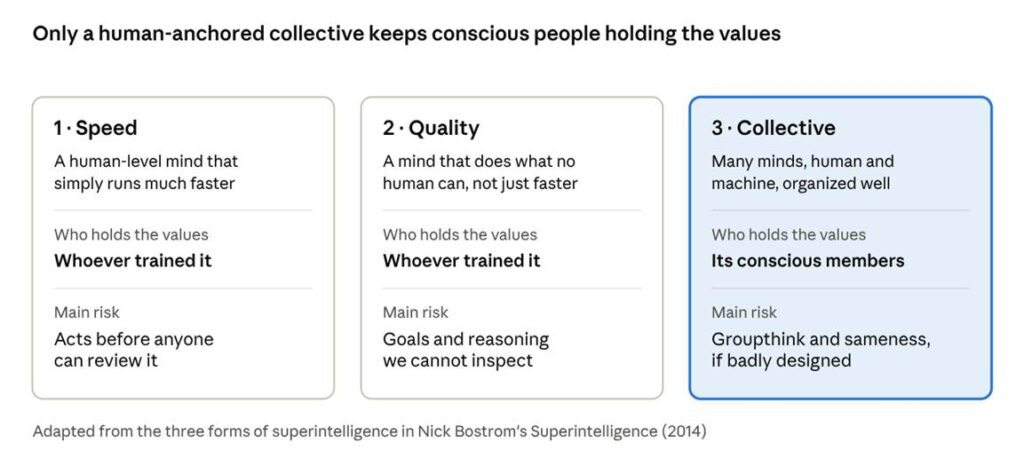
Three roads to superintelligence, adapted from Nick Bostrom
The deciding question is the middle row. On the first two roads, the values come from whoever trained the system. On the third, they can come from the conscious people inside it.
Two objections I take seriously
“Why not let the machines form the collective themselves?”
This is the strongest argument against my case, because it is where the industry is actually heading. More and more of what vendors ship is multi-agent: teams of AI agents dividing up work, checking each other and negotiating. Run that far enough and you get a collective superintelligence with no humans in it at all.
The risks of that path are already being mapped. In 2025, 44 researchers led by Lewis Hammond at the Cooperative AI Foundation catalogued what goes wrong when advanced AI agents interact. They named three failure modes: miscoordination, where agents share a goal but fail to cooperate; conflict, where their goals differ; and collusion, where they cooperate in ways we never wanted. Among the risk factors they list is emergent agency, behavior that belongs to the group and that no single developer designed (Hammond et al.).
That last point is the crux for me. An AI-only collective is the speed and quality roads again, only with the values even harder to trace: partly from whoever trained each agent, partly from dynamics nobody chose. I don’t want people kept in the collective for sentimental reasons. They are the only members who have a stake in the outcome and who can be held to account for it.
The fair counterpoint is speed. Humans are slow, and nobody wants a person approving every API call. So the answer is not humans everywhere. It is humans at the right places: wherever values are set, wherever a decision can’t be undone, and wherever the collective is about to act on people who had no say.
“Crowds go wrong too.”
They do, and anyone who has watched a market bubble or a social media pile-on knows it. A simple experiment by Jan Lorenz and colleagues at ETH Zurich asked 144 people to estimate facts over several rounds. When people could see each other’s answers, the diversity of estimates collapsed but accuracy did not improve. Worse, people’s confidence went up (Lorenz et al., PNAS). A group can talk itself into being surer and no wiser.
Notice that this is the same failure the AI studies found: convergence that looks like consensus. Collectives are not wise by default. They are wise by design, which means protecting independent thinking before people see each other’s views, keeping minority positions visible, and separating the decisions a crowd is good at from the ones it isn’t. The architecture below is built around exactly those safeguards.
The way forward: a human-anchored collective
In the paper I co-authored on artificial collective intelligence, we called this the wisdom imperative: if we are going to build minds more capable than our own, human wisdom has to be designed in, not hoped for. Here is what that looks like as an architecture.
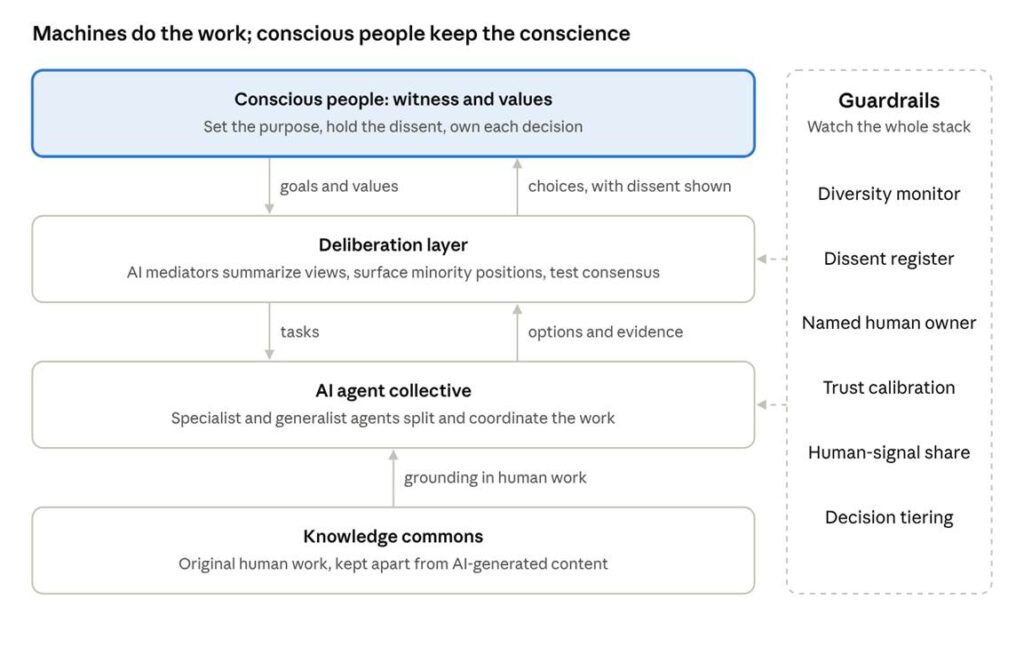
A human-anchored collective: four layers and the guardrails around them
Read it from the bottom up.
A knowledge commons keeps original human work separate from machine output. Model collapse tells us the fresh signal comes from people; this layer makes sure we can still find it.
An AI agent collective does most of the heavy lifting. Specialist agents go deep, generalist agents connect, and the network is shaped to the task, as the simulation work suggests.
A deliberation layer sits between the machines and the people. This is where tools like the Habermas Machine and Polis belong: summarizing what everyone thinks, pulling minority views into the open, and testing whether a consensus is real or merely smoothed over.
Conscious people sit at the top. They set the purpose, keep the dissent alive, and own each decision by name. They are the witness. No other layer can do this job, because no other layer can answer for itself.
Running down the side are the guardrails that keep the whole thing honest: a monitor for creeping sameness, a register of dissent, a named owner for every consequential decision, a check on whether people trust the machines at the right moments, a running count of how much genuinely human work is still flowing in, and the rule that decides which decisions machines may take alone.
One design rule ties it together: tier the decisions. Reversible, low-stakes work can run in machine-only loops at machine speed. Decisions that set values, can’t be undone, or land on people who had no voice go up to the human layer, every time. That keeps the collective fast where speed is safe and slow where it should be.
None of these pieces is speculative. Each exists today in some form. What is missing is the decision to assemble them deliberately, and to treat the human layer as the core of the system rather than its slowest part.
What leaders can do on Monday
[Your story goes here, 3 to 5 sentences.] A real moment from your own work where a human-AI team got this balance right or wrong: the situation, what the AI did, what the people did or failed to do, and what it cost or saved. Anonymize the client. Delete this note when done.
None of this waits for superintelligence. Every company rolling out copilots and agents is already building a human-AI collective, whether it designs one or not. Here is what I’d put on the agenda, with a measure for each so it doesn’t stay a slogan.
| Practice | Why it matters | What to measure | Starting target |
| Think first, then prompt | Protects the diversity that AI flattens | Similarity of team outputs before and after AI use | No more than a 5% rise |
| Match the pairing to the task | Human-AI teams win only where humans already have the edge | Accuracy of human overrides of AI recommendations | Above 70% of overrides proven right |
| Keep dissent visible | AI summaries can manufacture false consensus | Share of major decisions with a documented minority view | At least 1 in 3 |
| Let stakeholders set values | Public input reduced bias with no capability loss | Employees or customers consulted on AI principles each year | A representative sample, every year |
| Name the accountable human | Only a conscious person can answer for a decision | Consequential AI decisions with a named human owner | 100% |
| Guard the human signal | Models trained on AI output degrade | Share of training and knowledge-base content that is original human work | Tracked, and never allowed to fall unnoticed |
| Tier the decisions | Keeps machines fast where speed is safe, and humans where it isn’t | Irreversible or value-setting AI actions with a human approval step | 100% |
The targets are my starting points, not benchmarks from a study. Calibrate them against your own baseline in the first quarter. What matters is that a leadership team is looking at collective health, not just model accuracy.
The crowd needs a witness
There is an old image in the Upanishads of two birds on the same tree. One eats the fruit, sweet and bitter. The other simply watches. I keep coming back to it when I think about where AI is heading.
We are building the first bird at extraordinary speed: systems that consume everything and act on it. The question for this decade is whether we keep the second bird in the tree. In a single machine, we don’t yet know how to build it. In a collective, we already have it. It is us, as long as we stay awake, stay diverse, and stay in the loop.
Superintelligence may well arrive. My bet is that the version worth having will not be a single mind that outgrows us. It will be a collective, much smarter than any of its parts, with conscious people still holding the conscience. I don’t see that as a brake on ambition. It is the wisdom imperative in practice, and I think it is the road where getting there and staying safe point the same way.
Let’s keep the conversation going
If this piece sparked a question, a disagreement or an idea worth building, I’d like to hear it. Every week I share transformation stories from the field, what’s actually working with emerging technologies inside large enterprises, and the strategic thinking behind both.
Dr. Rishi Kumar · Founder and Chief Transformation Officer, MatchingFit · Forbes Technology Council
- LinkedIn: linkedin.com/in/contactrishi
- X: @contactrishi
- Medium: medium.com/@contact-rishi
Sources
Collective intelligence in human groups
- Evidence for a collective intelligence factor in the performance of human groups: Woolley, Chabris, Pentland, Hashmi and Malone, Science, 2010
- Reanalysis questioning the general factor: Credé and Howardson, Journal of Applied Psychology, 2017 (ScienceDaily summary)
- Smart groups of smart people: evidence for IQ as the origin of collective intelligence: Bates and Gupta, Intelligence
- Quantifying collective intelligence in human groups: Riedl, Kim, Gupta, Malone and Woolley, PNAS, 2021
- How social influence can undermine the wisdom of crowd effect: Lorenz, Rauhut, Schweitzer and Helbing, PNAS, 2011
AI inside human collectives
- AI can help humans find common ground in democratic deliberation: Tessler et al., Science, 2024, with critiques reported by Singularity Hub
- Collective Constitutional AI: Anthropic and the Collective Intelligence Project, 2023
- When combinations of humans and AI are useful: a systematic review and meta-analysis: Vaccaro, Almaatouq and Malone, Nature Human Behaviour, 2024
- Generative AI enhances individual creativity but reduces the collective diversity of novel content: Doshi and Hauser, Science Advances, 2024
- AI models collapse when trained on recursively generated data: Shumailov et al., Nature, 2024
- How large language models can reshape collective intelligence: Burton et al., Nature Human Behaviour, 2024
- Large AI models are cultural and social technologies: Farrell, Gopnik, Shalizi and Evans, Science, 2025
AI collectives and superintelligence
- Multi-agent risks from advanced AI: Hammond et al., Cooperative AI Foundation, 2025
- Artificial collectives of specialists and generalists excel at different tasks: Meluso, Hébert-Dufresne, Riedl and Gao, 2026 preprint
- Nick Bostrom, Superintelligence: Paths, Dangers, Strategies, Oxford University Press, 2014 (summary of the forms of superintelligence)
- Fortune on the launch of Meta Superintelligence Labs, June 30, 2025
Consciousness
- Consciousness: here, there but not everywhere: Tononi and Koch, 2014
- The two birds appear in the Mundaka Upanishad (3.1.1) and the Shvetashvatara Upanishad (4.6).
