
From birdsong and whale conversations to the emergence of Intelligence Discovery — a scientific, technological and philosophical frontier that could redefine our understanding of intelligence.
1. The Intelligence We Have Been Overlooking
Imagine standing in a forest just before sunrise.
As daylight begins to break, hundreds of birds start communicating. Some are establishing territory, others are maintaining social connections, warning of potential threats or engaging in exchanges whose complexity remains poorly understood.
Thousands of miles away, sperm whales exchange patterned sequences of clicks beneath the ocean. Elephants communicate through low-frequency rumbles, sometimes beyond the range of human hearing. Dolphins produce whistles and acoustic signals within complex social networks.
These communication systems existed long before humans developed written language, invented computers or began contemplating artificial intelligence.
Yet, for all our technological sophistication, we understand only a fraction of what is happening within these biological networks.
There is a certain irony in humanity’s pursuit of artificial general intelligence. We are investing extraordinary resources in creating new forms of intelligence while continuing to discover how little we understand about the diversity of intelligence already present on our planet.
What if artificial intelligence could help close that gap?
What if some of the most important discoveries in the next decade come not from teaching machines to think like humans, but from using machines to understand how other living beings perceive, communicate and coordinate?
This is no longer merely a philosophical question.
Researchers across the Earth Species Project, Project CETI, Google DeepMind, MIT, UC Berkeley and other scientific institutions are developing computational methods to investigate nonhuman communication at unprecedented scale.
The emerging field sits at the intersection of artificial intelligence, behavioral science, evolutionary biology, linguistics, neuroscience and bioacoustics.
Its implications could reach far beyond understanding animal sounds.
It could reshape how we define intelligence itself.
2. Communication, Language, Intelligence and Consciousness Are Not the Same
Before exploring the technology, it is important to establish four distinctions frequently overlooked in popular discussions about animal intelligence.
Communication involves the exchange of signals that influence another individual’s behavior or convey information.
Language generally involves structured systems of communication capable of representing meaning, although scientists continue to debate which characteristics are necessary for a system to qualify as language.
Intelligence encompasses capabilities such as learning, adaptation, reasoning, problem-solving and responding effectively to changing environments.
Consciousness concerns subjective experience and awareness. Its relationship with intelligence remains a subject of scientific and philosophical debate.
An animal does not need human-equivalent language to demonstrate sophisticated intelligence. Similarly, an AI system capable of generating an apparently meaningful response does not necessarily possess consciousness or subjective understanding.
This distinction connects directly with a subject I explored in my earlier article, The Witness in the Crowd: Human Consciousness, Collective Intelligence and a Saner Path to Superintelligence.
The challenge is not simply determining whether animals communicate like humans. It is understanding their communication systems on their own terms.
A dolphin’s acoustic perception, an elephant’s social memory and a bird’s learned vocal repertoire reflect different evolutionary histories and environmental demands.
Human language should be a useful reference point, not the universal standard against which every form of intelligence is measured.
3. The Emergence of Animal Language Processing
Natural Language Processing (NLP) transformed how computers interact with human language.
An emerging research direction known as Animal Language Processing (ALP) seeks to apply some of these computational advances to nonhuman communication.
The Earth Species Project articulated this framework in April 2026, bringing together AI, linguistics, bioacoustics and animal behavior research.
At a fundamental level, machine learning is not restricted to human words.
It can discover relationships in numerical, visual, temporal and acoustic information. A model trained on animal vocalizations can learn to distinguish different signals, identify recurring acoustic sequences and generate hypotheses about their potential functions.
However, animal communication presents a challenge fundamentally different from human-language processing.
When developing an English-to-French translation model, researchers can access dictionaries, multilingual documents and examples of equivalent meaning.
There is no Rosetta Stone for sperm whales.
No established dictionary translates elephant rumbles into English. No comprehensive dataset explains the meaning of every dolphin whistle.
Scientists must simultaneously discover the structure of the communication system and investigate what its signals actually do.
This makes ALP an unusually demanding scientific problem. It also makes it an extraordinary opportunity for AI research.
Research references:
- Animal Language Processing: An AI Convergence in Animal Communication — Earth Species Project, April 2026
- Will artificial intelligence let us talk to the animals? — Nature, 2024
- Toward understanding the communication in sperm whales — iScience, 2022
4. When Birds Begin Interacting With Artificial Intelligence
From passive observation to interactive experimentation
Birds occupy a particularly interesting place in animal communication research because many species learn their vocalizations through social and cultural processes.
Zebra finches, in particular, have become important scientific models for investigating vocal learning, social communication and acoustic perception.
In a 2026 research preprint, scientists analyzed more than 1.5 million calls produced by female zebra finches during vocal exchanges.
They subsequently developed ZF-AIM, a generative acoustic interaction model capable of producing responses during real-time interactions with birds.
Traditional playback experiments typically involve presenting animals with prerecorded signals and observing their reactions.
Interactive AI changes the experimental possibilities. Instead of presenting a predetermined recording, the system can generate acoustic responses that adapt to an ongoing exchange.
Researchers reported evidence of flexible response behavior, coordinated call production and changes in acoustic characteristics during interactions.
The achievement is scientifically significant, but its boundaries matter. The experiments do not establish that the AI understands the semantic meaning of the calls or that birds regard the model as a fully equivalent social partner.
The research remains preliminary until its findings have undergone further scientific validation.
What it demonstrates is a new experimental capability: AI can participate in a controlled acoustic exchange, rather than simply analyze recordings afterward.
Do birds understand vocal categories beyond their acoustic similarity?
Another important development came in June 2026 when Julie Elie, a researcher affiliated with UC Berkeley, received the Coller Dolittle Prize for progress toward two-way interspecies communication.
Her research investigates how zebra finches categorize vocal signals and associate calls with their communicative functions.
The scientific importance lies in exploring whether birds distinguish calls based on something more than their physical acoustic characteristics.
This begins to address one of the most difficult questions in the field: how do animals organize and interpret their own communicative signals?
Receiving the prize recognizes significant progress, not the completion of a bird-language translator.
The mathematical structure of birdsong
In August 2026, researchers published a study in Science Advances examining the learned songs of Bengalese finches.
They identified recurring sequences of notes whose frequency distribution followed a power law resembling statistical patterns found in human language.
Similar findings had been reported in humpback whale songs in 2025.
Such patterns may arise partly through cultural transmission, where signals are learned, repeated and modified over generations.
However, a statistical resemblance does not establish grammar, vocabulary or semantic equivalence with human language.
The more interesting possibility is that different species may independently develop certain common organizational properties when communication is learned and culturally transmitted.
Scaling research across thousands of species
In August 2026, the Earth Species Project introduced BirdCODE, a model designed to detect and classify vocal events across more than 9,000 bird species.
This addresses a different scientific challenge: researchers must first identify when a particular animal is vocalizing before they can investigate the function of its calls.
Together with established tools such as BirdNET, BirdCODE demonstrates how AI can make large-scale acoustic research more practical.
The combination of automated detection, representation learning and interactive experimentation is creating a powerful new toolkit for studying the communication systems of birds.
Research references:
- AI-powered playbacks engage in flexible vocal interactions with zebra finches — 2026 preprint
- Julie Elie wins the 2026 Coller Dolittle Prize — Berkeley Neuroscience
- Language-like statistical structure arises in learned signaling — Science Advances, August 2026
- Statistical structure in humpback whale song — Science, 2025
- BirdCODE: Detecting bird communication at scale — Earth Species Project, August 2026
- BirdNET: A deep learning solution for avian diversity monitoring — Ecological Informatics
5. Project CETI: Investigating the Hidden Communication Systems of Whales
Among the most ambitious initiatives in this field is Project CETI, the Cetacean Translation Initiative.
Its focus is sperm whales — highly social marine mammals whose communication includes sequences of clicks known as codas.
The project combines underwater sensing, robotics, machine learning, linguistics and decades of marine behavioral research.
Discovering combinatorial acoustic structures
In May 2024, researchers associated with MIT and Project CETI published a landmark study in Nature Communications.
Analyzing 8,719 sperm whale codas, they identified four important dimensions of acoustic variation:
- Rhythm: the relative timing of clicks.
- Tempo: the overall speed of a sequence.
- Rubato: subtle timing adjustments within a sequence.
- Ornamentation: additional clicks that modify an existing pattern.
The researchers found that these acoustic features could be combined, creating a much richer repertoire of distinguishable codas than previous classifications suggested.
The study described this organization using the analogy of a phonetic alphabet.
However, this should not be confused with a decoded alphabet in the human sense. The researchers identified an organized acoustic system; the communicative functions of many codas remain unknown.
The discovery of vowel-like acoustic properties
In April 2026, researchers published further findings in Proceedings of the Royal Society B.
They identified spectral properties within sperm whale codas that exhibit organizational similarities to certain characteristics of human vowels.
This suggests that whale communication contains dimensions of acoustic variation beyond click timing alone.
It does not mean whales pronounce human vowels. Rather, researchers are discovering additional ways in which their acoustic signals are structured.
In June 2026, another study investigated statistical relationships between successive codas exchanged by pairs of sperm whales.
The ability to identify relationships between calls and subsequent responses may help researchers investigate the dynamics of vocal exchanges.
From communication science to conservation
One of the most practically significant developments emerged from research into the effects of shipping noise.
A June 2026 study reported changes in sperm whale coda duration associated with the presence of vessels.
The implications are substantial.
Environmental disturbances may affect not only where marine animals live or how they move, but also their acoustic behavior.
Understanding these effects could inform marine conservation, shipping policies, underwater infrastructure planning and ocean noise management.
This is an important example of why the field does not need to achieve complete language translation before delivering meaningful scientific and societal value.
Research references:
- Toward understanding the communication in sperm whales — Scientific research roadmap, 2022
- Contextual and combinatorial structure in sperm whale vocalisations — Nature Communications, May 2024
- The phonology of sperm whale coda vowels — Proceedings of the Royal Society B, April 2026
- Exploring statistical relations between coda sequences of Dominica sperm whale pairs — June 2026
- Evidence for the influence of shipping underwater radiated noise on sperm whale coda structure — June 2026
- Project CETI — Research and scientific publications
6. DolphinGemma: When Foundation Models Move Beyond Human Language
In April 2025, Google announced DolphinGemma, developed in collaboration with Georgia Tech and the Wild Dolphin Project.
The initiative builds on approximately four decades of observations of wild Atlantic spotted dolphins.
DolphinGemma is an approximately 400-million-parameter audio foundation model that learns from dolphin vocalizations.
Its underlying principle resembles next-token prediction in large language models, but instead of processing human words, it analyzes sequences of acoustic information.
The model is designed to identify recurring sound patterns and predict likely subsequent acoustic signals.
Google’s SoundStream audio technology helps represent audio in a format suitable for computational modeling. These representations allow the system to investigate relationships within complex vocal sequences.
DolphinGemma represents a shift from developing narrowly specialized sound classifiers toward exploring more flexible generative models for animal communication research.
Two fundamentally different approaches
It is important to distinguish DolphinGemma from another related initiative, Cetacean Hearing Augmentation Telemetry (CHAT).
DolphinGemma investigates naturally occurring dolphin sounds and their structure.
CHAT explores whether humans and dolphins can learn shared acoustic signals associated with particular objects or activities.
The first approach investigates an existing biological communication system. The second attempts to develop a limited shared communication interface.
Neither currently establishes unrestricted translation between human and dolphin language.
Nevertheless, their combination could eventually support experiments that connect pattern discovery with more controlled behavioral interactions.
DolphinGemma should still be understood as a developing research model rather than a commercially available, scientifically validated animal translator.
Research references:
- DolphinGemma: How AI can decipher dolphin communication — Google, April 2025
- DolphinGemma — Google DeepMind technical overview
7. Elephants, Wolves and Primates: Understanding Social Intelligence
Communication is often inseparable from social organization.
The ability to recognize individuals, coordinate movements, maintain relationships and respond to changing circumstances can be essential to survival.
Elephants and individually specific vocal signals
A study published in Nature Ecology & Evolution in 2024 used machine learning and playback experiments to investigate whether African elephants address one another through individual-specific calls.
The researchers found evidence that certain acoustic features could help predict the intended recipient of a call.
Playback experiments showed that elephants responded differently to calls originally directed toward them.
The findings suggest that elephants may use vocal labels resembling names without necessarily copying the recipient’s own sounds.
A subsequent author correction addressed errors in playback scoring, with the authors reporting that the corrected analysis did not qualitatively change the conclusions.
The research does not establish a comprehensive vocabulary of elephant names. But it provides compelling evidence of sophisticated individual-specific vocal addressing.
Collective communication within elephant herds
In October 2026, research published in Scientific Reports explored overlapping vocalizations in wild elephant groups.
Scientists used machine learning to investigate whether information associated with social situations could be extracted from complex choruses.
The findings indicated that collective rumbling contains information relevant to behavioral context and that acoustic convergence can occur during group exchanges.
However, the researchers also identified limitations in generalizing context classification across individuals.
That qualification is important. A model may learn characteristics of particular elephants rather than universal signals associated with specific behavior.
The study nevertheless highlights a promising frontier: investigating communication at the level of the group, not only the individual.
Wolves and distributed social coordination
In Yellowstone National Park, the Cry Wolf Project is using AI to analyze extensive acoustic recordings of wolves.
Research is exploring individual identification, vocal patterns and their relationships with social behavior.
Wolves provide an interesting opportunity to study the communication mechanisms of highly coordinated social groups.
Their behaviors may also inspire research into distributed decision-making, although directly transferring biological mechanisms into artificial systems requires considerable scientific work.
Primates and the importance of scientific disagreement
Research published in Science in 2024 suggested that marmoset monkeys may use individually directed vocal labels.
Subsequent scientific debate has raised questions about alternative interpretations.
This is not a weakness of the research process. It is how science progresses.
In an emerging field where media narratives can quickly move from intriguing evidence to extraordinary conclusions, disagreement and independent replication are essential.
Research references:
- African elephants address one another with individually specific name-like calls — Nature Ecology & Evolution, 2024
- Author correction — Nature Ecology & Evolution, 2025
- Social context information and acoustic convergence in elephant vocal choruses — Scientific Reports, October 2026
- Listening to the wolves of Yellowstone — Earth Species Project, October 2026
- Vocal labeling in marmosets — Science, 2024
- Scientific critique of marmoset vocal labeling research
8. The Technology Architecture Behind Animal Communication AI
What does it actually take to build an AI system capable of investigating animal communication?
A single large language model is not sufficient.
The research requires an integrated scientific and technological architecture that connects environmental observation, machine learning and experimental validation.
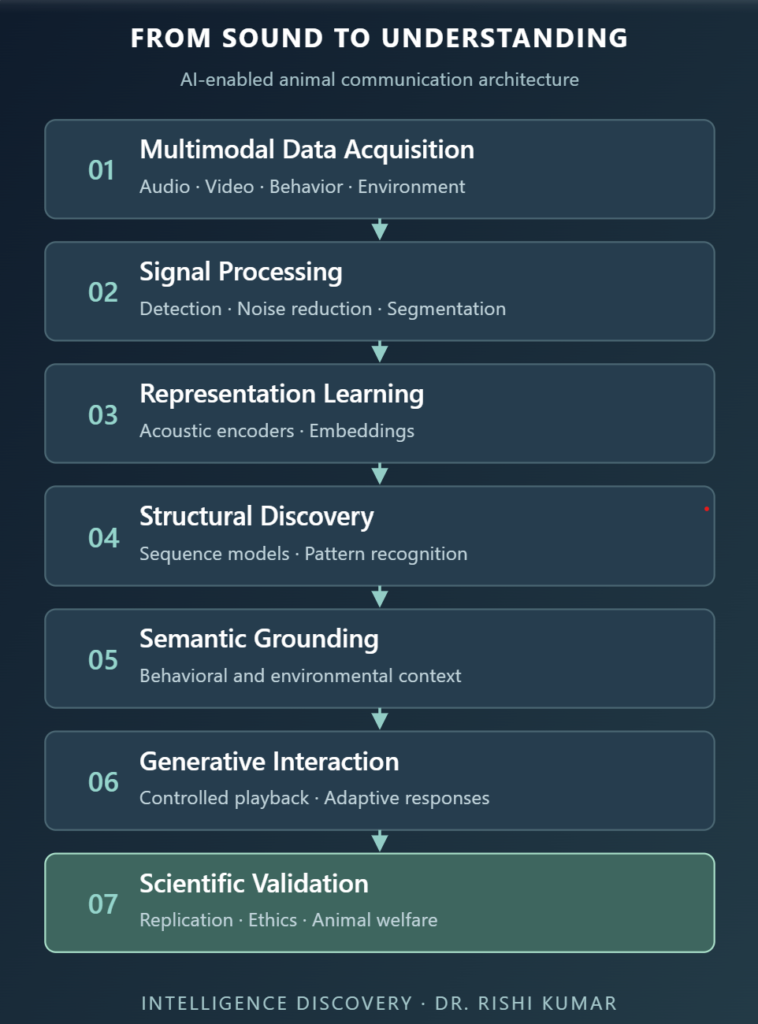
Layer 1: Multimodal data acquisition
Researchers collect information using technologies such as:
- Underwater hydrophones and acoustic arrays.
- Autonomous environmental recording stations.
- Animal-mounted sensors and tracking devices.
- High-resolution video and behavioral observations.
- Environmental and geospatial sensors.
The objective is not simply to collect audio. It is to understand who produced a signal, when it occurred, what was happening around the animal and how others responded.
Layer 2: Signal processing and acoustic event detection
Natural environments are acoustically complex.
Recordings can contain wind, water, insects, machinery, multiple animals and overlapping vocalizations.
Signal processing and machine learning help researchers detect relevant acoustic events, reduce interference and separate or distinguish overlapping sources where possible.
This stage is fundamental because errors in identifying a signal can propagate throughout the analytical process.
Layer 3: Representation learning
AI encoders transform audio recordings into numerical representations known as embeddings.
These representations can capture useful relationships among acoustic signals without requiring researchers to manually define every relevant characteristic.
Self-supervised learning can exploit large quantities of unlabeled recordings, which is particularly valuable when the meanings of signals are not already known.
Layer 4: Sequence modeling and structural discovery
Transformer-based and other sequential architectures can investigate how vocalizations are organized over time.
Potential tasks include identifying:
- Recurring acoustic units.
- Relationships between successive calls.
- Changes in timing or frequency.
- Individual-specific patterns.
- Differences between populations or social groups.
The resulting structures provide hypotheses for further investigation.
Layer 5: Multimodal and behavioral grounding
This is arguably the most important layer.
A vocalization becomes scientifically more informative when researchers can associate it with observable context.
A particular call may occur during feeding, social separation, reunion or exposure to a threat.
But correlations alone are insufficient. Researchers must account for alternative explanations, including environmental conditions, individual identity and coincidental timing.
Layer 6: Generative interaction
Generative acoustic models can produce candidate vocal signals for carefully designed playback experiments.
Researchers can then observe whether animals respond in predicted ways.
Interactive experiments may offer stronger evidence than passive observation, provided that appropriate controls and welfare safeguards are maintained.
Layer 7: Scientific validation and governance
The final layer encompasses independent replication, uncertainty estimation, data provenance, animal welfare, ecological safeguards and ethical review.
The objective is not merely to develop an impressive AI demonstration. It is to establish a scientifically credible understanding of communication.
The most important output of this architecture is not a translation interface.
It is a validated body of knowledge.
Technical research references:
- NatureLM-audio: An Audio-Language Foundation Model for Bioacoustics — ICLR 2025
- Project CETI: Interdisciplinary research architecture and scientific roadmap
9. Foundation Models for the Living Planet
Foundation models transformed artificial intelligence by enabling capabilities learned from large datasets to be adapted across multiple tasks.
A comparable transition is now emerging in bioacoustics.
The Earth Species Project’s NatureLM-audio, presented at ICLR 2025, is an audio-language foundation model specifically designed for bioacoustic applications.
It allows researchers to investigate animal sounds through a natural-language interface, combining acoustic representation capabilities with language-model functionality.
Importantly, describing an animal sound in human language is not equivalent to translating what the animal intended to communicate.
The model’s current scientific utility lies in supporting acoustic analysis and related research tasks.
BEANS-Next and ROOTS
In October 2026, the Earth Species Project introduced two additional research resources designed to expand the capabilities of bioacoustic AI:
BEANS-Next: A benchmark intended to evaluate a broader range of bioacoustic understanding tasks beyond conventional species and call classification.
ROOTS: A large-scale audio-language training resource incorporating recordings, associated descriptions and generated content.
These initiatives are strategically significant because they address the infrastructure needed to support research across species and applications.
The history of enterprise AI has repeatedly demonstrated that progress requires more than powerful algorithms.
It requires appropriate data, standardized evaluation, reliable infrastructure, reproducibility and effective governance.
Bioacoustic AI faces many of the same challenges, with an additional complication: the underlying semantic ground truth is often unknown.
The next generation of foundation models for nature must therefore be judged not only by how accurately they classify sounds, but also by how effectively they support testable scientific discoveries.
Research references:
- NatureLM-audio — ICLR 2025 conference paper
- NatureLM-audio — Technical documentation
- BEANS-Next and ROOTS — Earth Species Project, October 2026
10. The Most Difficult Problem: Discovering Meaning
Imagine an AI model that correctly predicts the next sound in a whale’s vocal exchange 90% of the time.
Would that establish that the model understands whale communication?
Not necessarily.
It may have learned a reliable statistical relationship without discovering the function of the signal.
This is an illustrative example of the semantic grounding problem: how do we connect an abstract representation with something meaningful in the physical or social world?
Consider hearing an unfamiliar human language without access to a translation dictionary.
Even if you observe that a particular expression occurs whenever someone enters a room, the expression could mean hello, welcome, someone’s name or something entirely different.
Repeated observation provides clues. Controlled experimentation can help distinguish between competing explanations.
Animal communication presents an additional complication. Other species may perceive environmental information that humans do not readily perceive.
Dolphins use echolocation. Elephants are sensitive to low-frequency acoustic information. Many birds perceive aspects of light and sound differently from humans.
A communication system is shaped by the sensory world, physical capabilities and social environment of the species using it.
Discovering meaning therefore requires far more than audio analysis.
Six major scientific challenges
| Challenge | Why it matters |
|---|---|
| Semantic grounding | Acoustic patterns must be connected with experimentally supported communicative functions. |
| Individual variation | Models may confuse individual identity with the meaning of a signal. |
| Population differences | Communication patterns may vary across geographic or cultural groups. |
| Multimodal context | Relevant information may involve posture, movement, scent, touch or other sensory signals. |
| Generalization | Findings from one population or experimental setting may not transfer to another. |
| Anthropomorphism | Researchers may unintentionally impose human concepts on nonhuman behavior. |
Addressing these challenges will require long-term interdisciplinary collaboration.
It will also require AI systems that communicate uncertainty, support reproducible experiments and distinguish observations from hypotheses.
In this field, a confident but incorrect interpretation may be more damaging than a model that acknowledges its limitations.
11. My Proposed Intelligence Discovery Framework
My perspective is that the growing field of AI-enabled animal communication research represents a broader opportunity within artificial intelligence.
I call this perspective Intelligence Discovery.
Intelligence Discovery is the use of artificial intelligence as a scientific instrument to investigate, characterize and learn from diverse forms of naturally evolved intelligence.
It is not a claim that we can directly measure consciousness through vocalizations. Nor is it an established scientific discipline or a universally accepted maturity standard.
It is a conceptual framework for thinking about the next frontier of AI-enabled scientific discovery.
I propose six interconnected stages.
| Stage | Capability | Scientific objective |
|---|---|---|
| 1. Observe | Collect multimodal biological and environmental information. | Establish reliable evidence. |
| 2. Recognize | Identify acoustic events, species and individual signals. | Determine what is present. |
| 3. Discover | Identify recurring patterns and organizational structures. | Generate scientific hypotheses. |
| 4. Contextualize | Associate patterns with behavior and environmental conditions. | Investigate potential functions. |
| 5. Validate | Test interpretations through controlled experiments and replication. | Establish credible knowledge. |
| 6. Learn and interact | Develop ethically governed interactions and explore transferable principles. | Expand scientific and technological understanding. |
The framework is iterative rather than strictly linear.
New discoveries should inform better data collection. Failed experiments should lead to revised hypotheses. Improved models should enable more sophisticated scientific questions.
The framework also differentiates three complementary directions in the evolution of AI:
Artificial Intelligence — developing computational systems capable of performing intelligent tasks.
Intelligence Augmentation — using AI to expand human knowledge, reasoning and decision-making capabilities.
Intelligence Discovery — using AI to investigate forms of intelligence that exist beyond the conventional boundaries of human understanding.
The third direction deserves greater attention.
For decades, we have primarily assessed AI by its ability to replicate, automate or enhance human capabilities.
Intelligence Discovery asks a different question:
What can artificial intelligence help humanity discover about intelligence itself?
12. What Nature Could Teach the Next Generation of AI Systems
Biological evolution has produced extraordinary adaptive systems without following the engineering conventions of modern computing.
Bird flocks coordinate movement without a central controller. Social insects can collectively make decisions. Marine mammals acquire and transmit learned behaviors. Animals adapt to environments where information is incomplete and circumstances constantly change.
These systems offer interesting research directions for artificial intelligence.
| Biological phenomenon | Potential AI research direction |
|---|---|
| Flock coordination | Decentralized multi-agent coordination |
| Collective decision-making | Distributed consensus mechanisms |
| Learned vocal behavior | Continual learning and social learning |
| Animal social networks | Persistent agent relationships and memory |
| Adaptive signaling | Context-sensitive agent communication |
| Biological energy constraints | Resource-efficient computation |
| Behavioral adaptation | Resilient autonomous systems |
Bio-inspired computing is not new. Neural networks, evolutionary algorithms and swarm intelligence have long drawn inspiration from nature.
What could change is the depth and precision with which researchers investigate naturally evolved intelligence.
AI may help uncover coordination mechanisms and communication structures that were previously difficult to observe.
For researchers building agentic systems, this raises compelling questions.
Can teams of AI agents coordinate effectively without continuous centralized orchestration? Can communication protocols become more efficient through adaptation? Can distributed systems remain resilient when individual agents fail?
These are research directions, not conclusions established by animal communication studies.
Nature offers inspiration. Engineering and scientific validation determine whether that inspiration produces useful technology.
13. The Strategic and Commercial Opportunities for Business Leaders
The commercial value of bioacoustic intelligence does not depend on achieving complete interspecies translation.
Several opportunities already have credible foundations, while others require additional research and validation.
Environmental and biodiversity intelligence
Organizations could deploy acoustic monitoring systems to support assessments of ecological conditions across forests, agricultural land and industrial development sites.
Applications include species detection, habitat monitoring and identifying changes in ecosystem activity.
Agriculture and animal welfare
Validated acoustic and behavioral models could help livestock producers identify abnormal behavior or possible distress.
The objective would be earlier intervention and improved welfare, rather than speculative translation of animal thoughts.
Maritime operations
Underwater acoustic monitoring could help shipping companies, offshore energy developers and marine authorities assess potential impacts on wildlife.
This could inform operating practices, infrastructure planning and conservation measures.
Financial services and environmental risk
Investors and insurers may eventually incorporate more continuous ecological observations into environmental due diligence and risk assessments.
However, the relationship between acoustic observations and financial risk must be established through appropriate ecological and economic models.
Sustainable retail and supply chains
Retailers and consumer goods organizations increasingly face questions concerning agricultural practices, sourcing and environmental stewardship.
Bioacoustic intelligence could contribute to more evidence-based monitoring of selected biodiversity and animal-welfare indicators in supply chains.
Advanced AI infrastructure
Technology companies may find opportunities in specialized audio models, edge computing, environmental sensors, scientific data platforms and multimodal analytical tools.
The infrastructure required for this field could support applications extending beyond animal communication.
Where executives should focus
| Opportunity | Relative maturity | Strategic priority |
|---|---|---|
| Automated species detection | Established | Evaluate deployment |
| Passive acoustic monitoring | Established | Integrate with environmental programs |
| Behavioral context classification | Emerging | Run controlled pilots |
| Animal-welfare analytics | Application-dependent | Validate measurable outcomes |
| Multimodal biological foundation models | Emerging research | Explore strategic partnerships |
| Generalizable animal-language translation | Unproven | Monitor research developments |
For executives, the appropriate strategy is to distinguish current deployable capabilities from longer-term scientific possibilities.
Organizations should invest in validated use cases, establish measurable baselines and treat more speculative opportunities as structured research rather than immediate commercial commitments.
14. The Ethical Responsibility of Interspecies AI
Every breakthrough in communication creates the possibility of influence.
If scientists eventually discover how particular signals affect animal behavior, the ability to generate those signals could become both a valuable conservation tool and a source of ecological risk.
Imagine synthetic calls attracting animals toward unsafe locations, disrupting social relationships or interfering with naturally occurring communication.
Sensitive acoustic data could also reveal the locations of endangered species.
These risks are not arguments against research. They are arguments for responsible research and deployment.
In my view, a governance framework for interspecies AI should establish five foundational principles.
Animal welfare by design. Research and deployment should prioritize minimizing distress and harm.
Scientific integrity. Claims about meaning should be grounded in observable evidence, appropriate controls and reproducibility.
Ecological non-interference. Interventions should be evaluated for unintended effects on individual animals, populations and ecosystems.
Responsible data stewardship. Sensitive wildlife recordings, location information and generative capabilities should be managed according to their associated risks.
Interdisciplinary oversight. Decisions should involve biologists, ecologists, AI researchers, ethicists and relevant regulatory authorities.
A 2026 paper published in Topoi examines ethical challenges associated with using machine learning to decode animal communication.
The subject deserves attention now, while technological capabilities are still developing.
The ability to influence another living being does not automatically confer the moral authority to do so.
Research reference: Can we talk to the animals? The ethics of using machine learning to decode animal communication — Topoi, 2026
15. A Possible Research and Innovation Roadmap: 2027–2035
Predicting scientific breakthroughs is inherently uncertain.
However, based on existing research directions, a plausible scenario for the evolution of bioacoustic intelligence can be considered across three horizons.
Horizon 1: 2027–2028 — Scaling observation and discovery
Potential developments:
- Improved species and individual recognition.
- More comprehensive acoustic datasets.
- Better multimodal research platforms.
- Increased deployment of environmental monitoring systems.
- More standardized model evaluation.
- Expanded controlled acoustic interaction experiments.
The primary focus is likely to remain observation, classification and structural discovery.
Horizon 2: 2029–2031 — Contextual interpretation
Potential developments:
- More sophisticated links between signals and behavioral contexts.
- Improved generalization across individuals and populations.
- Expanded experimental validation of particular communicative functions.
- Increased application of acoustic intelligence to conservation and animal welfare.
- More advanced generative models with stronger safeguards.
Progress during this period could establish more reliable interpretations of selected communication signals.
Horizon 3: 2032–2035 — Experimentally grounded interaction
Potential developments:
- More capable, species-specific interactive research systems.
- Limited communication interfaces built around experimentally validated signals.
- Deeper investigation of social and collective intelligence.
- New biologically inspired AI architectures.
- More mature ethical and regulatory frameworks for interspecies interaction.
Whether unrestricted interspecies conversation becomes possible remains unknown. It may require substantially different scientific approaches, and some species’ communication systems may not support direct translation into human language.
These horizons are scenarios, not predictions or commitments by the research organizations mentioned.
The most realistic objective is continued expansion of scientifically validated understanding.
16. The Connection to AGI and the Future of Intelligence
Today’s pursuit of artificial general intelligence is largely built around human-defined benchmarks.
We evaluate systems based on their abilities to solve mathematical problems, write software, reason through complex tasks, generate language and perform activities associated with human expertise.
These are important capabilities.
But they represent only part of the broader landscape of intelligence.
A bee colony exhibits collective decision-making without possessing a central human-like executive. A bird adapts to environmental uncertainty using a remarkably compact biological system. Social animals maintain relationships and coordinate behavior through mechanisms that do not necessarily resemble human reasoning.
This diversity raises an important question for AGI research.
Should general intelligence be defined exclusively through the replication of human cognitive capabilities, or should we also investigate the broader principles that enable adaptive behavior across biological and artificial systems?
Intelligence Discovery provides a complementary research direction.
Rather than assuming that human cognition offers the only useful blueprint, we could use AI to investigate alternative mechanisms of learning, adaptation, coordination and communication.
The relationship between these mechanisms and consciousness must remain a separate scientific and philosophical question.
Neither complex animal vocalizations nor sophisticated AI-generated responses establish subjective experience on their own.
Nevertheless, broadening our understanding of intelligence may ultimately influence how we design, evaluate and govern future artificial systems.
17. The Executive Lesson: Intelligence Is More Than Information Processing
Having spent more than two decades working at the intersection of business strategy, enterprise transformation and emerging technologies, I have seen organizations repeatedly confront a distinction between technological capability and meaningful outcomes.
The availability of more data does not necessarily produce better decisions.
More automation does not automatically create organizational agility.
More AI-generated content does not necessarily improve human understanding.
The same distinction is central to animal communication research.
An algorithm may process millions of vocalizations without establishing their meaning. A generative model may reproduce an acoustic signal without understanding its function.
What matters is the connection between the information, its context and the outcome it produces.
Enterprise leaders can learn from this scientific challenge.
We should design AI initiatives around validated outcomes rather than superficial demonstrations. We should preserve human judgment where uncertainty remains material. We should encourage multidisciplinary collaboration instead of treating intelligence as exclusively a technology problem.
Perhaps most importantly, we should remain open to discovering better ways of organizing and understanding complex systems.
Nature reminds us that intelligence is not confined to a single architecture, operating model or mode of communication.
Conclusion: Humanity’s Next Great Scientific Instrument
The telescope allowed humanity to observe distant worlds.
The microscope revealed biological structures that had always existed beyond the limits of our vision.
Artificial intelligence may become another instrument of comparable scientific importance — one that helps us investigate forms of communication and intelligence that have remained partly inaccessible to us.
We are not yet translating whale conversations into English.
We cannot confidently interpret every bird call, discover an elephant’s thoughts or establish an animal’s subjective experience through acoustic data alone.
The science remains incomplete.
But that is precisely what makes this frontier so extraordinary.
For generations, humanity has looked toward the stars wondering whether other forms of intelligence exist somewhere in the universe.
Meanwhile, we have lived alongside species whose cognitive abilities, social relationships and communication systems we are still learning to appreciate.
Perhaps we have been asking only half of the right question.
Instead of asking exclusively how intelligent machines can become, we should also ask what intelligent machines can help humanity discover.
The future of artificial intelligence should not be limited to creating machines that resemble us. It should also encompass expanding our understanding of the world we share.
The next frontier may not be artificial intelligence alone.
It may be Intelligence Discovery.
And perhaps the greatest achievement of AI will not be teaching machines to speak like humans, but finally teaching humanity how to listen.
